
Fashion label Gorman learns the dangers of ignoring ethical questionnaires
23 May 2016
Gorman is a hot brand in Australia. It truly has raving fans who go mad for its clothes with their distinctive bold patterns. Not only that, but it also has its social and ethical compliance policy posted on the website, to reassure its customers that this is a company with values. It has a Gorman Organic range.
Not that it made any difference when a huge ethical storm hit a month ago. Was it caught out using child labour to stitch its clothes? Was it shown to be using dangerous suppliers paying pittance wages?
No. It decided not to take part in a survey by Baptist World Aid Australia on ethical practices in the Australian fashion industry.
The organisation had a penalty system against companies that didn’t comply with demands for information. They duly gave Gorman an “F” in their report.
Journalists don’t look closely at the methodology of reports about how companies do on sustainability
High street staple companies like H&M got good scores, reflecting their policies and practices. And it seems that, certainly amongst some Australian consumers, the expectation is that smaller brands of high-end clothes should be able to do at least as well, and preferably better.
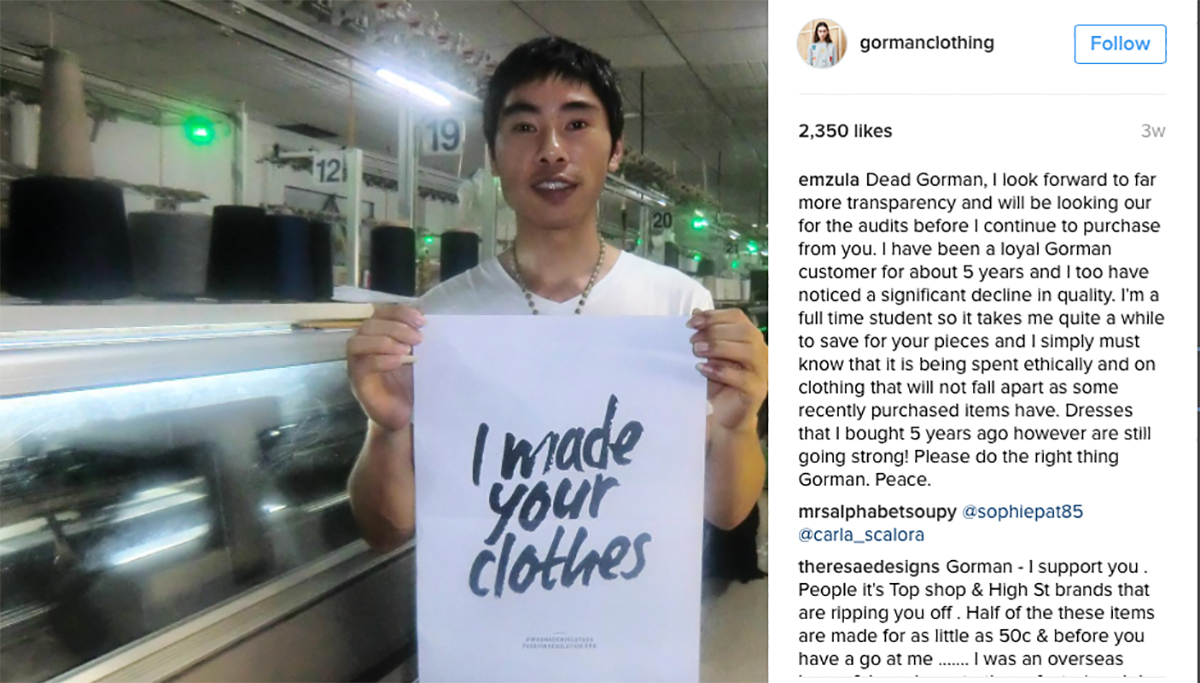
Many people did not notice nor care that the ‘F’ score was because the company didn’t take part, rather than because it operates awful practices. Criticism began to emerge on Gorman’s social media presence. When it posted a picture on Instagram as part of the ‘who made my clothes’ series, it provoked a furious backlash from a number of apparently loyal fans who felt betrayed by what they were hearing.
One critic, for instance posted: “An independent audit has awarded you an F. It’s going to take more than a staged photo PR move to assure ethical shoppers.”
The company has been caught on the back foot, and has tried to plead its case. Founder Lisa Gorman was quoted by The Age newspaper as saying: “We have a social and ethical policy in place which must be adhered to by factories that manufacture Gorman. In the coming months we will be publishing our audits online. It is clear that this is what our customer wants most and we are happy to provide this.”
Such a response did little to quell the criticism however, since a significant group of people, having seen press coverage of the report, have taken it very much as read that the F grade was deserved, and nothing much the company says about it is going to persuade them otherwise. Such is the social media blame storm once it gets going.
Now, I don’t know how good or bad Gorman’s practices actually are. The mere fact that there’s a code of conduct and audits are carried out doesn’t guarantee much, as we know. But it is a sign of intent, and the company will surely know that it’s going to be under particular scrutiny over the coming year so it has to up its game on making those processes robust.
I do feel some sympathy for them, however. Lots of companies get bombarded with questionnaires from all sorts of groups trying to gather information on their particular issue of interest. Most of the big corporates pick and choose which ones are worth the considerable time required, and wave the rest in the direction of their published CSR / sustainability report.
For smaller companies, it can be even more challenging, given the smaller amount of resource that might be available for providing reams of data.
Not only that, but sometimes the methodology that groups use for their indices or reports can be highly suspect. The worst look like they’ve been cobbled together on the back of a beer mat, based on unrealistic assumptions about what actually works in the real world, and what can be implemented by different sorts of businesses. Sometimes, if you look at an exercise and suspect it’s basically rigged against you, it might be advisable to decline.
There are times when that’s the right thing to do. This might even have been one of those times.
But the recent controversy highlights the dangers of refusing to engage. Journalists, by and large, don’t look very closely at the methodology of reports and indices about how companies do on sustainability. They just don’t. Highly respected frameworks that have had thousands of hours of informed development, such as the Dow Jones Group Sustainability Index may get less coverage than something produced by some campaign group based on zero knowledge of what constitutes best practice.
I’m not saying there aren’t good questionnaires that get to the nub of an issue. Just that you can’t rely on journalists to be bothered enough to sort out, on your behalf, which is which.
So what should Gorman do now?
A couple of things are worth noting. First, quite a few of those critics were probably not customers anyway, including some who claimed that they were. You shouldn’t say that or allude to it, if you’re the company, and it shouldn’t breed complacency. But it’s just to note that one publicity storm with some critical social media commentary may not be the end of the world – provided the right moves are taken from now on.
Let’s assume the company is actually doing quite a good job, as it claims, and it’s been unfairly targeted. The key thing next would be to make a feature of what its doing. There are a number of brands for whom ethical practices are part and parcel of the guarantee of quality, and that absolutely should become part of Gorman’s story over the next couple of years.
That means going beyond the audits being published. It means making the supply chain more transparent in ways that are engaging and bring the brand to life. It means making it a higher profile secondary feature of the brand, something customers can feel good about, rather than simply a compliance statement to reassure people that the hygiene factor is being taken care of.
And for the first six months or maybe the first year, there will be some that will kick back against it, who will criticise and refuse to believe. But over time, if the company is being transparent and honest, it will flip over from being a point of weakness to being a point of strength.
Does it mean that, in future, you just have to fill in every questionnaire that crosses your desk? Hopefully not, because providing all that data can actually get in the way of driving performance, which is surely more important. The key is to build greater transparency into your processes, so that people can be pointed to the information you publish. That does take time, but if you’re in charge of your own process, you can use it to benefit the business, not to distract time away from doing so.
Gorman may find this whole episode a pain, but it’s actually quite hopeful. Any sign that there are a significant number of customers who actually care about how their clothes are made moves us forward. It is apathy that is the real enemy of an ambitious, quality-focused small brand, not criticism.
Subscribe to Updates
Enter your email address to subscribe to this blog and receive notifications of new posts by email.
We will never share your details with any third party
