
Richard Branson’s evolution in corporate social responsibility
23 March 2016
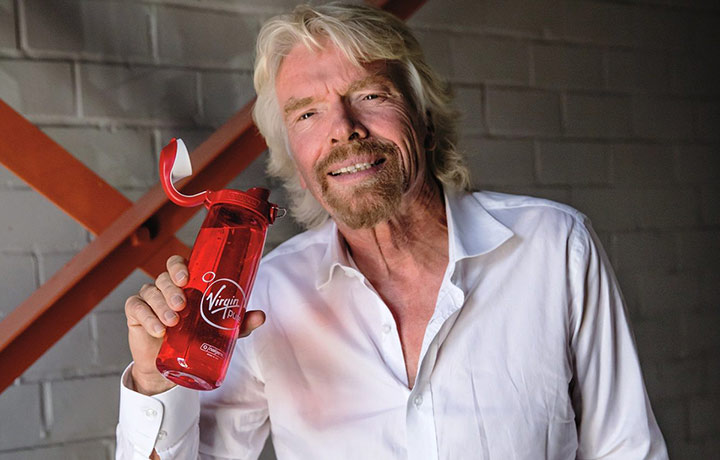
In common with certain other ‘elder statesmen’ business leaders, you’re more likely to see commentary from Richard Branson on key social and environmental issues than you are purely business ones these days.
Just yesterday was a case in point. Branson was writing about World Water Day, talking about water scarcity across the globe and the projected 1.8 billion people that will affected by it by 2025 unless we take action.
It’s not just random musings. Virgin has partnered with WHOLE EARTH Water. As part of the arrangement, Virgin filters and bottles its own water and donates 10% of the proceeds to the fund aimed at reducing water scarcity. It’s a nice programme, although water isn’t a key area for Virgin where it can make the most impact.
So is Richard Branson the epitome now of the green entrepreneur? Is his business career a single-minded study in how to do business in a socially responsible and sustainable way? It’s no criticism of Branson to note that it’s a bit more complicated than that.
The modern Branson is a different business leader to the one of the last century.
In the early decades, the issues didn’t exactly loom large on the mainstream business landscape. Although the term ‘corporate social responsibility’ had been termed as an academic concept, it hadn’t emerged as an active process and the majority of businesses still believed that all they really needed to do was to obey the law and otherwise get on with it.
Branson was not obviously on the journey that would bring him to the point where he has arrived today. In his early years, as he discusses frankly in his own books, he got into trouble for evading tax by pretending to export records and then bringing them back in to sell in the UK. There was a strong hippy counter-cultural element about Virgin at the time, but this wasn’t any kind of political statement – it was no more than a trick to make more money at the expense of the taxman. Branson was caught and heavily fined. The lesson was learnt, and such episodes were not repeated.
You could have argued that Virgin’s historical market positioning placed it in an ideal position to explore what it means to be socially responsible. Branson enjoyed nothing better than to find an industry with an established old guard of fat and lazy companies who’d stopped serving customers well because they didn’t have to, and shake things up. In principle, if Virgin as the ‘plucky outsider’ could offer better deals for customers and challenge self-serving monopolies then it could do a lot of social good just by doing business.
In practice, Virgin’s track record in achieving that has been mixed. Some of its businesses have been highly regarded and have been successful. Others have failed to deliver, and have been discarded. Like most successful entrepreneurs who have nothing to lose, Branson has been cheerfully ready to acknowledge failures and talk about the lessons learnt.
But in those early years, although they had energy and daring, Virgin businesses weren’t inherently better managed, or more deliberately socially responsible. They weren’t the worst. They didn’t deliberately seek to profit by demonstrably bad practices. But they weren’t great.

And Branson’s personal brand, developed from the start as the most visible part of Virgin’s public image, was certainly a product of its time in those early years. Virgin traded on sex appeal, and Branson thrived with promotions where he would be surrounded by scantily clad women to drive home the message that, whatever else Virgin might be, it was sexy.
However, as Branson became a larger and more influential figure as his businesses did well, he began to show signs that it wasn’t all about the PR opportunities and the showgirls.
In 1990 when Saddam Hussein’s forced invaded Kuwait, Branson saw the TV pictures of refugees flooding over the border, and immediately picked up the phone to King Hussein of Jordan to offer help. Virgin flew out blankets to help people survive the freezing cold of the desert nights, as well as medical supplies as a result.
When Saddam took British hostages, he used his connection to King Hussein to plead for their release, and to offer that Virgin would fly needed medical supplies into Iraq in return. The initiative led to the visit by British politician Ted Heath to secure the release of the women and children that were being held.
Clearly, Branson had a sense of personal responsibility and the view that he could take the initiative when there was a clear and urgent need. But how did this begin to make the move towards ‘corporate’ responsibility?
The process really began to kick in around 2003 when Branson was considering whether or not to build his own oil refinery in the face of spiraling oil prices. At that point, Ted Turner advised him not to do it, and sat him down with 20 scientists to provide his first insights into global warming.

This was then compounded in 2006 when a personal session with Al Gore, going over the material that would become Gore’s famous presentation ‘An Inconvenient Truth’, persuaded Branson that the issue was huge and that large scale action was needed by business leaders. Virgin was about to launch a new air route to Dubai. Reflecting on that fact brought it home what the consequences of ‘business as usual’ actually were.
So it was at this point that Branson sat down with senior decision makers within Virgin to discuss what it meant for the company. Branson decided that Virgin had to be committed to what he labelled ‘Gaia Capitalism’ after the theory promoted by James Lovelock. It resulted in a public pledge that Virgin would commit $3bn from the profits of its travel businesses to develop biofuels, and to place Virgin at the forefront of the attempt to reduce the impact of the business of transport.
In the event, the profits of those businesses may not have delivered sufficient to meet the original headline target. But there is no doubting the energy and drive that has gone since then into sourcing clean energy and reducing day to day environmental impacts.
Branson has also added to those efforts by offering a $25m prize for a commercial-scale way of extracting carbon dioxide from the atmosphere.
Undoubtedly, not everyone is impressed with all of this. Biofuels may turn out not to be the best solution to our future energy needs for all sorts of practical reasons. But for the whole of Branson’s life, his businesses have been engaged on a process of trying things out, failing at some and learning the lessons to arrive at the solutions that work.
If he’d been the CEO for a listed company, no doubt one of those failures would have seen him kicked out long ago. But the freedom to learn from his mistakes has been one of his best assets over the years, and it may yet enable him to come up with the commercial breakthrough that will help move the issue forwards in the years to come.
The modern Branson is a different business leader to the one of the last century. Whether it’s climate change, water, recycling or global poverty, his focus has moved to the big issues. And when he talks about internal business culture, a lot of it is now about progressive workplace policies. Virgin, for instance, has experimented with initiatives such as letting staff take as much holiday as they want as part of their approach to employee engagement.
People who will accept nothing less than perfection will still find plenty to criticise. But in terms of creative problem-solving influencers looking for solutions that can be pushed to scale, Richard Branson needs to be taken seriously as one of the key players.
Subscribe to Updates
Enter your email address to subscribe to this blog and receive notifications of new posts by email.
We will never share your details with any third party
