
The charismatic boss: Is it good to work for a business hotshot?
20 February 2016

They are the rock stars of the business world. The charismatic bosses. The ones that are admired by their peers, feared by their subordinates, fêted by political leaders and media editors. In a world where success counts for everything, they are the epitome of the qualities that you need to succeed. Or so it seems.
Does the presence of a charismatic leader make it more or less likely a business will behave in a socially responsible way? And what are they like to work for – do you crave the excitement that would come of working for a charismatic boss? Would it be good for your career?
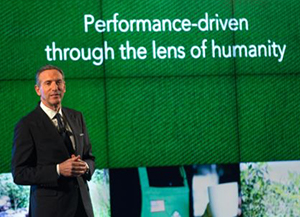
There are certainly examples of charismatic leaders who have become high profile beacons of social responsibility. Take Howard Schultz of Starbucks, for instance. He has helped to create one of the most successful and ubiquitous brands in the world, but he has also made that company an active corporate citizen. He has made pretty courageous public stands, for instance over race and same-sex marriage.
It’s not always comfortable for people working for him. He has acknowledged in the past that his tendency to latch onto an issue and announce a new programme has the effect of stressing out his team. But it’s just one of those things they have to put up with. It’s part of what the company is about so long as he’s in charge.
The worst leaders believe they’re always right. The best leaders have the confidence to know that they're not
Then there’s Paul Polman at Unilever, who told the company’s shareholders from the start that they were going to have to accept things on his terms, or else find other companies to invest in. No quarterly earnings reports. The company was going to focus on the long term, and that meant sustainability was going to be as important to the business as profits.
But if we have a few shining examples of charismatic leadership with a conscience, there are a number of others who have become watchwords for irresponsibility. In the US, Chuck Prince, formerly of Citigroup comes to mind. In the UK, Fred Goodwin of Royal Bank of Scotland. These were leaders that made headlines. The exuded the confidence of being fully in control. They had a reputation for taking no prisoners and for high-stakes deal-making.
They were not much interested in issues of social responsibility. And they crashed and burned.
But don’t be fooled into thinking that lack of interest in social responsibility was the causal factor there. One could also point to Sir Peter Davis, the business grandee who ended his career as chief at major retailer Sainsbury’s. He was chairman of Business in the Community and actively concerned on matters of social responsibility for his business. Unfortunately, he was also unsuccessful even though his downfall was less spectacular.
So if it’s not about commitment to social responsibility, is there a difference between these two groups, other than the outcome?
There are multiple behaviours that get labeled under the umbrella term of ‘charisma’.
Descriptions of the leadership styles of Schultz and Polman by people who know them are clear that a key factor of their approach is one of hiring the best people and then being open to the messages they receive from the people around them. They take responsibility for making the tough decisions, and show leadership. But they also seek to empower people around them, and are open to new information.
By contrast, those who crashed and burned became known for assuming always that they were the smartest people in the room. Prince’s management style was criticised (before his ultimate downfall, not just with the benefit of hindsight) as someone who “doesn’t take advice and says too much … He doesn’t really trust anyone else.”
Goodwin’s “aggressive, macho management style” was widely blamed for RBS’s disastrous attempted takeover of ABN Amro, since it left employees too scared to speak out about problems.
The initial success of those two, followed by their dramatic failure, very much taps into the perennial question of ‘do jerks succeed best in business?’
Studies have shown that over-confident, arrogant and selfish behaviours can serve people well when seeking to rise up the corporate ladder. And such behaviours are often mistaken for charisma.
But over-confidence eases very quickly into bullying and intimidating. The problem with that, apart from the obvious, is that it discourages people from telling you what you need to hear. Good charismatic leaders seem to go out of their way to break down the barriers that keep them from hearing the bad news and seeing the world as it truly is. Jerks who make it so far up the tree that no-one dares tell them anything they don’t want to here become isolated. And without a flow of reliable unfiltered information, good decision-making becomes a matter of luck not judgement.
Plus it’s worth noting that the venerable old tome ‘Built to Last’ – the seminal book by Jim Collins and Jerry Porras about why enduringly successful companies got that way, ruled against the charismatic leader as a feature. Many of the most successful companies had leaders who shunned the spotlight.

But, of course, it wasn’t the act of shunning the spotlight that made them successful. It was the same mantra that Schultz and Polman have already demonstrated. Hire the right people and build the strongest team that you can. Encourage open discussion and dissent in order to make the best quality decisions. Enduringly successful businesses weren’t big risk-takers.
And the leaders of those consistent businesses concentrated on building a base of values within the company. A “purpose beyond profit”. That meant that when they eventually moved on, the things that made the company work stayed in place. With the self-centred rockstars, when they leave (or get carried out) then their values and priorities disappear from the company almost overnight.
Back to our two charismatic groups. The similarity between them was that the high profile charismatic leaders shared with the bullies one important element – a degree of narcissism. A study into the performance records of leaders with narcissistic tendencies found one key tendency – they clustered at the extreme ends of success and failure. They were the ones with the courage to take risks, because of their huge reservoirs of self-belief. Sometimes those risks paid off big time. Sometimes they ended in disaster. And it could well be that the difference between those outcomes came down to how much the people concerned were able to counter the downside of narcissism – that tendency to isolation.
The worst leaders believe they’re always right. The best leaders have the confidence to know that they’re not.
So is it good for your career to end up working for a charismatic boss?
Certainly, you can learn a lot from them, and of course association with success never looks bad on the CV.
But the key question is this. Do they encourage you to tell them the truth of what’s going on? Or do you find yourself scared in their presence in case you say the wrong thing? If it’s the latter case, you may be mistaking charisma for pure narcissism.
And you might want to get off that particular ship before it hits the rocks.
Some additional reading:
Harvard Business Review - Narcissistic Leaders: The Incredible Pros, the Inevitable Cons
Subscribe to Updates
Enter your email address to subscribe to this blog and receive notifications of new posts by email.
We will never share your details with any third party
