
What if everyone knows your pay?
14 February 2016

You spend a lot of your life at work, so you want a workplace that is run in a socially responsible way. Of course. Because you want to be treated as an equal in a company that values diversity. You want to have fair and well-structured appraisals so that you get rewarded for your hard work and loyalty.
But how far would you be prepared to go in finding the socially responsible ideal?
A number of companies are experimenting with extreme transparency. And, in particular, they’ve focused on complete transparency on how much everyone gets paid.
There is no issue more potentially toxic than the question of how much do you get paid versus what your colleagues get paid? Time and time again it’s been shown to be an issue that can disrupt the best run of workplaces.
That moment when you find out that you’re being paid less than that colleague who does the same job as you and has been in the company for much less time. And add to that your perception that they actually do their job less well than you do. Well, you get the idea.
Once you’ve gotten used to it, it stops being remarkable and just becomes the way things are around here.
Companies that have tried it report that the simple process of transparency helps to bring such issues out into the open and forces the firm to create pay structures that are demonstrably fair and explainable. That can mean that the above scenario doesn’t happen, or if it does it happens for reasons that you understand.
One such company is tech start-up Buffer. They publish the formula that is used to calculate everybody’s salary and it looks like this.
- They create a base price with the value of the role, for which they use standard data for the US market as a whole. Then they add to this a key element that is related to the cost of living in that specific location, again using standard public data. Then there is a “role value adjustment” because what the national data says is the value of a role isn’t always what they agree, or it may be that the exact role they have isn’t fully covered by one of the national standard roles. At the end of that, they have the core amount for that role in that location.
- Then there is a multiplier based on experience. Four tiers. If you’re a beginner then you’re at base. If you’re intermediate, the base is multiplied by 1.1. Advanced, 1.2. And a true master – you guessed it – 1.3. So if your base level was 50,000 for a particular role, once you’d mastered your topic that multiplier would take you to 65,000.
- Another $3,000 per year is added for every dependent you have. It’s obviously a rare thing for a company to add money at all unrelated to the value you’re adding to the company, but rather recognising your own circumstances.
- Every year that an employee stays at Buffer, they get a general payrise of 5% on top of all the above.
- There’s one additional element where employees can choose either to take an additional $10,000 on salary or take it in additional stock options.
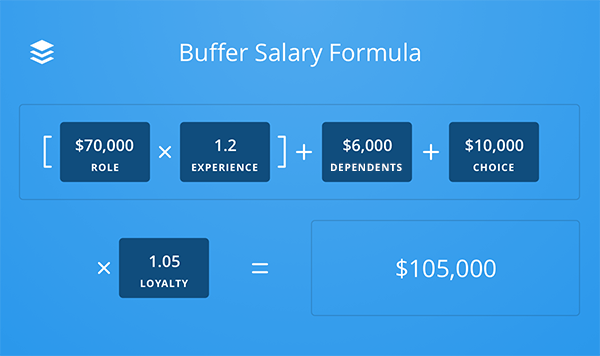
It’s a straightforward formula, and it applies to all jobs at every level. And in principle – other than the element of choice, which is down to the individual employee – any staff member should be able to take it and work out exactly how much their colleagues are being paid.
At Buffer, they don’t have to. The company publishes how much everyone gets paid on its public website. That’s the bit you might find most challenging.
Some people couldn’t live with it, and have left the company as a result. In some ways, though, that’s ok. Because the people who are attracted to work there are ones who do embrace this sort of culture of openness. And that helps to reinforce the culture in a way that helps to make it work.
The biggest problem some people have is that it leaves no room for negotiation. There are plenty of people who have become very good at walking into an appraisal meeting with their manager and highlighting their strengths and their unique contribution to a company’s success. They have nowhere to go. There is no discretionary fund to reward the highest achievers (or just as often, the most assertive self-marketers).
And you can see why some high achievers would find that galling. If you’re doing brilliant innovative work, but the only measure of that quality is how experienced you are. You might just feel under-appreciated.
But plenty of psychological studies have demonstrated our capacity for self-delusion. For every genuine high-performing genius that is recognised by management to be contributing well above their share of value to the company, there are ten other perfectly standard jocks with egos who put themselves in the same category with little or no material evidence at all.
So if no system will ever deliver a problem-free workplace, at least you might have a system that reduces that problem.
Buffer isn’t the only company to have experimented with this. SumAll has a similar approach, in that everyone in the company knows everyone else’s salaries. The system does, according to the CEO there, lead to a lot of discussions on the topic. But generally, it becomes the standard. Once you’ve gotten used to it, it stops being remarkable and just becomes the way things are around here.
Having seen organisations before now where people were hired at indefensibly cheap salaries and then managers spent their time persuading their bosses to give above average pay rises to keep hold of good people, you can see how transparency could force leaders to do better.
What do you think? Would it work for you?
Subscribe to Updates
Enter your email address to subscribe to this blog and receive notifications of new posts by email.
We will never share your details with any third party
