
Beware the gift that gives twice
08 February 2016

It’s become something of a trend. The “gift that gives twice” is some sort of ethical gift, and particularly one that supports a cause such as a charitable donation in the receiver’s name.
You’ve probably had at least one of these. I know I have. A former boss of mine once proudly handed me a card that told me that someone in a village somewhere on the other side of the world had received a goat in my name. To be honest, I wasn’t quite sure what to do with that information.
You may well have given such a gift as well. Or be considering it.
After all, you’re a socially responsible professional person. You want your gift giving to reflect your values, as much as anything else you would do.
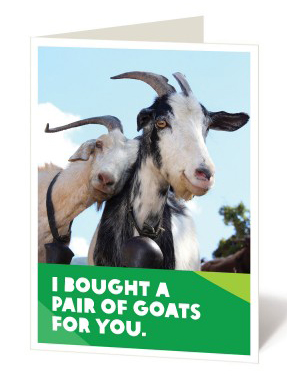
And goats, or chickens, schoolbooks or trees can make a big difference to the livelihoods of some of the poorest people in the world. Why wouldn’t that be a great gesture to make to someone you care about?
Now a newly published piece of research has raised the question just how much we get it right when we anticipate just how much our friends will appreciate such actions. In particular, we can wildly over-estimate how much the mere fact of it being something that has that ethical dimension may matter rather more to us than it does to anyone else.
Or as the Wall Street Journal put it, a Fairtrade fruitcake is still just a fruitcake.
The paper, “When Doing Good is Bad in Gift Giving: Mis-Predicting Appreciation of Socially Responsible Gifts”, published in the journal Organizational Behavior and Human Decision Processes, says that gift receivers generally appreciate socially responsible gifts less than givers had expected.
It does depend on the gift.
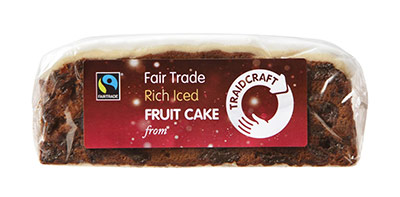
If the main benefit of the gift is going to some unnamed third party, however deserving, then receivers interpret this as indicating less commitment to them. Even when it’s a standard present that has an ethical element – such as Fairtrade coffee – the impression given is that it’s about making a statement about the giver, not the receiver. “Look at me – what an ethical person I am to give you such a present”.
Ouch. What a minefield human relationships can turn out to be.
How can you avoid the trap? The key is to show the recipient you really know and care about them. Any kind of generic present, whether it has an ethical edge or not, is just a token. Make something for them. Or involve them in the choice of present. And if they have a cause or an issue they care about, find something that celebrates that.
That’s what the research suggests, anyway. I’d add a few thoughts of my own.
Really, what we want to see is a world where mainstream choices can have an ethical dimension, and this isn’t so unusual that it draws attention or creates comment. To do that, we have to normalise that sort of choice. Routinely buy the right things. Don’t make a big statement about it. And that really means, when buying presents for other people, let the ethical dimension take a backseat. Take off the price. And take off the ethical statement as well.
Unless, of course, you know that your receiver so deeply cares about the same issues that they will positively appreciate knowing the full story. But then that’s rather the point isn’t it? It comes down to how well you know the person you’re giving to.
The key is to show the recipient you really know and care about them
Before I saw this item, I hadn’t appreciated just how much research had gone into the process of gift giving generally, and whether it was appreciated. Apparently, it was a standard thing – quite irrespective of ethical gift giving – that generally we are pretty rubbish at judging the recipient’s likelihood to enjoy a present. We’re too apt to project our own values and preferences onto our choice of presents.
If you’ve ever had someone give you a present with the words “I know you said you hate x, but I thought this particular one would win you over …”
No, it won’t. I’m willing to bet you hated it just as much as all the others.
In this case, it simply means avoid making ethical statements with your presents unless you’re pretty sure the ethical component is as important to your friend as it is to you. And whatever you do, don’t use the occasion of giving a present as an opportunity to proselytize. That’s not going to end well.
If, after all that, you still want to go ahead and get those goats – don’t say I didn’t warn you. You can find them here.
Now I think about it, I wonder what ever happened to my goat? You’d think I’d have been told.
The paper was by Lisa A. Cavanaugh of Marshall School of Business, Francesca Gino of Harvard and Gavan J. Fitzsimons of Fuqua School of Business. You can see it here.
Subscribe to Updates
Enter your email address to subscribe to this blog and receive notifications of new posts by email.
We will never share your details with any third party
